Solid Rocket Motor Grain Design
Introduction:
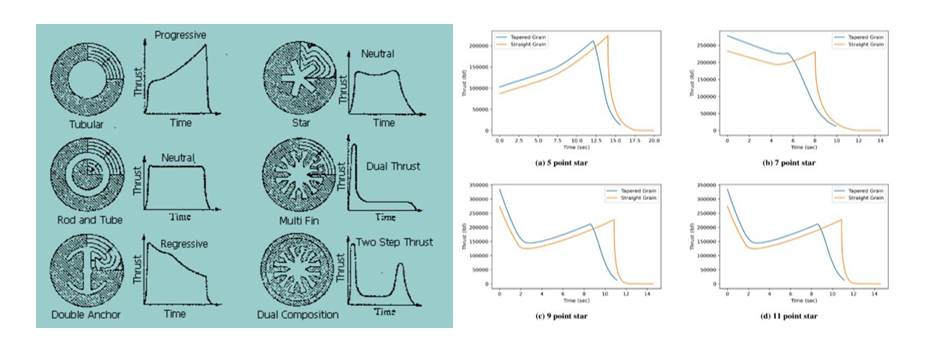
Solid rocket motors are widely used in aerospace applications due to their simplicity, reliability, high thrust-to-weight ratio, and ease of storage. A critical aspect of solid rocket motor design is the selection of propellant grain geometry, which directly influences the burning surface area, chamber pressure, thrust profile, and overall vehicle performance. Different grain geometries can produce progressive, regressive, or neutral thrust histories depending on how the burning area changes throughout combustion. Solid rocket motors utilizing specialized grain configurations have been employed in a variety of applications ranging from sounding rockets and amateur rocketry to major launch vehicles such as the Space Shuttle, Ariane 5, Vega, and Titan IV. Because grain geometry plays such a significant role in motor ballistics and flight performance, careful selection and optimization of the grain design are necessary to achieve mission objectives while maintaining safe operating conditions.
Grain Design:
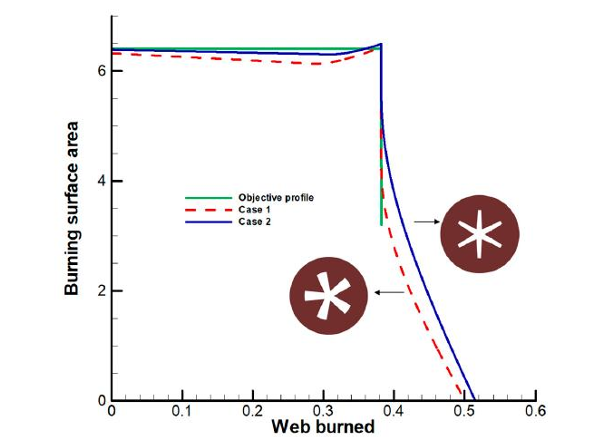
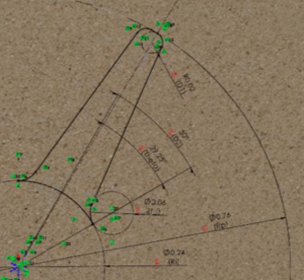
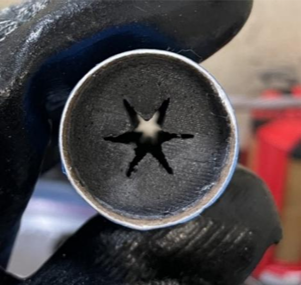
The motor developed for this project utilized a six-point star grain geometry as the basis for optimization. This geometry was selected due to its extensive flight heritage and its ability to produce a nearly neutral burn profile when properly designed. Previous research and operational rocket systems have demonstrated that star grains offer a high degree of control over burning area evolution throughout combustion. Unlike simpler cylindrical grains, the star configuration allows designers to tailor chamber pressure and thrust characteristics by adjusting parameters such as the number of points, fillet radii, and web thickness. A neutral burn was particularly desirable for this project because it helps maintain relatively constant chamber pressure and thrust, improving flight predictability while reducing the risk of damaging pressure spikes. Furthermore, a neutral thrust profile simplifies trajectory modeling and enables more efficient utilization of the available propellant throughout the motor burn.

Ballistics Simulation:
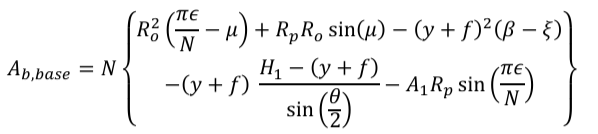
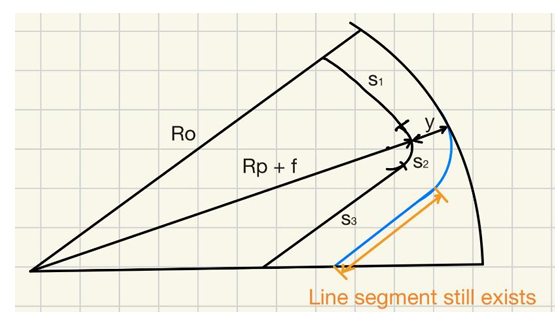
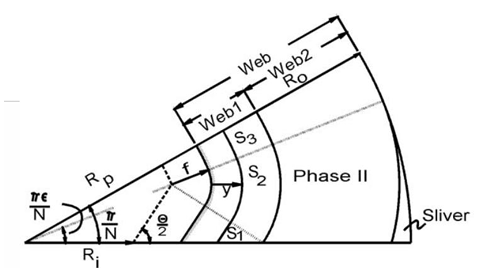
The pressure code was developed to predict the internal ballistic performance of the motor by modeling grain regression and the resulting changes in burning surface area over time. Using analytical methods presented by Hartfield et al., the code calculated the burning area as a function of web distance and divided the burn process into multiple phases based on the evolving star grain geometry. At each time step, the code updated the burning surface area and regression distance using pressure-dependent burn rate relationships. As the propellant burned, geometric equations were used to determine the active burning area and port area, which directly influenced chamber pressure and mass flow rate. By continuously updating these values throughout the burn, the code generated a chamber pressure history and propellant consumption profile that could later be used as inputs to the altitude simulation. This iterative approach allowed the motor's performance characteristics to be predicted before manufacturing and testing.



Altitude Code:
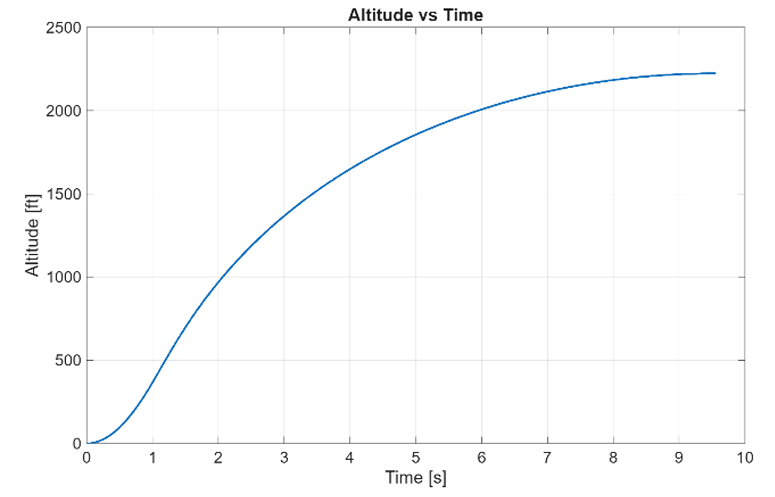
The altitude code simulated the rocket's flight trajectory using a two-dimensional flight model that assumed a constant launch angle and horizontal wind direction. Inputs from the ballistics code, including chamber pressure, mass flow rate, propellant mass, and burn area history, were used to calculate thrust throughout the flight. At each time step, the code computed the acceleration contributions from thrust, gravity, and aerodynamic drag. Thrust was calculated from chamber pressure and nozzle throat area, while drag was determined using the relative velocity between the rocket and atmospheric wind conditions. A wind profile based on NOAA power-law relationships was implemented to account for changes in wind speed with altitude. The total acceleration was then used to update the rocket's velocity and position vectors using numerical integration methods. This process continued until the rocket returned to ground level, allowing the maximum altitude and complete flight trajectory to be predicted.
Launch Test:
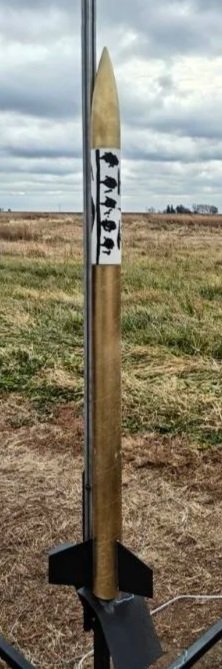
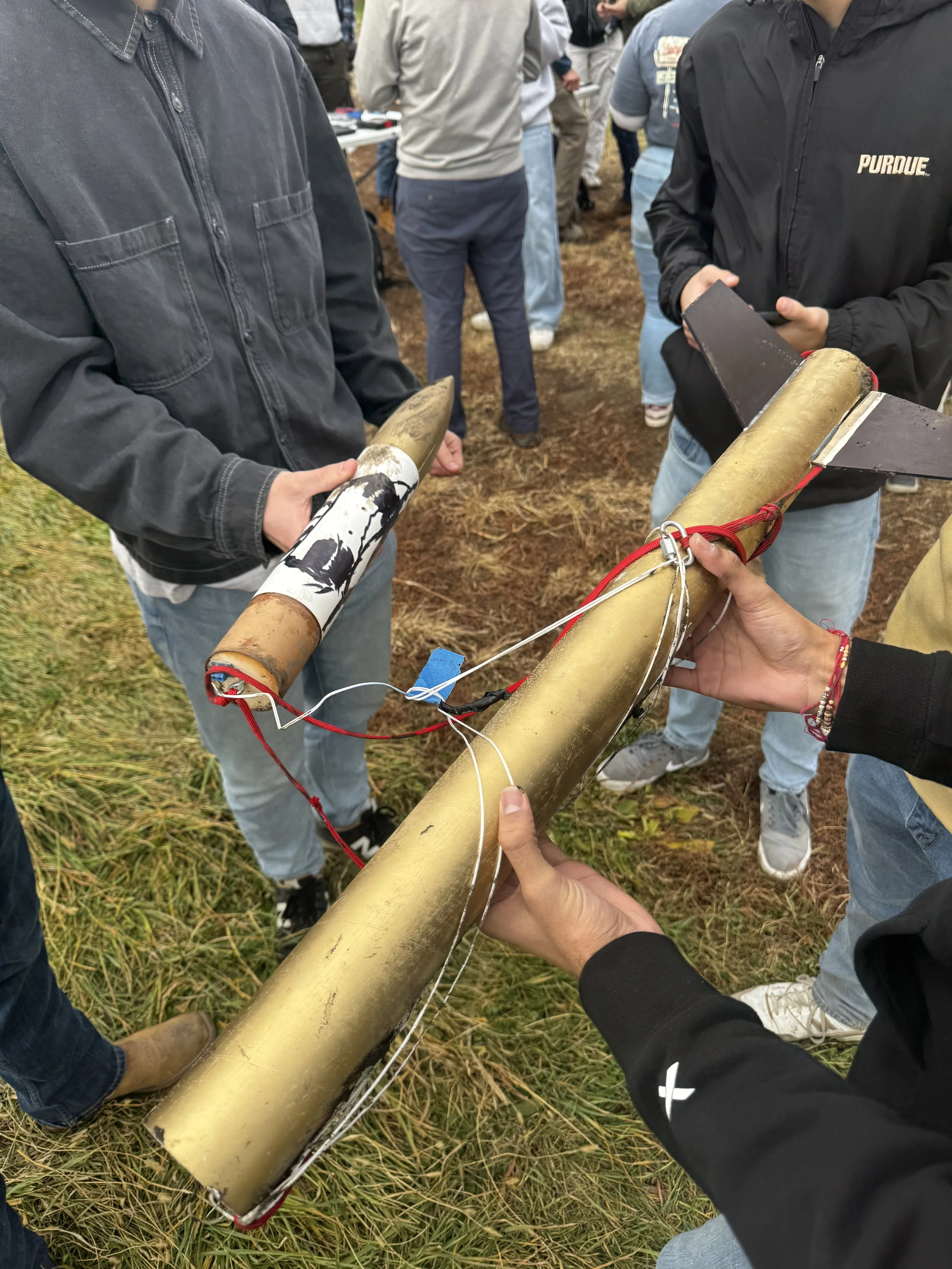
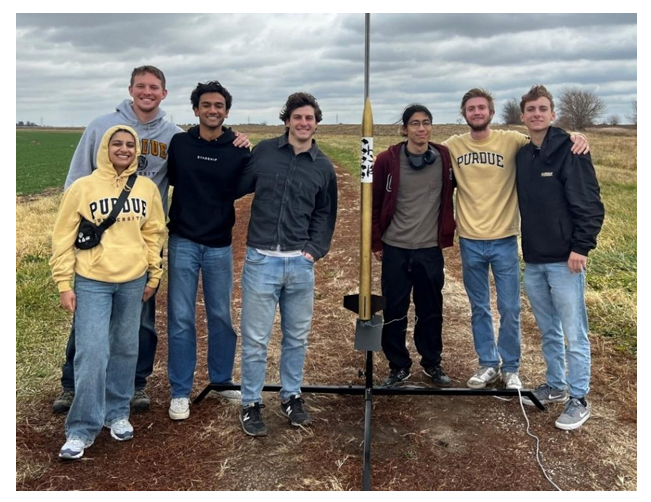
During launch testing, the rocket achieved a maximum measured altitude of 2,470 feet despite challenging environmental conditions. Wind speeds on launch day were approximately 10 m/s, requiring modifications to the wind model used in pre-flight analysis. Additionally, the rocket's air brakes detached prior to launch and were therefore excluded from the final performance predictions. Following recovery, the team discovered that the parachute had failed to deploy due to a shorted pyrotechnic ejection charge, causing the vehicle to impact the ground without recovery system deployment. Despite these issues, the rocket remained largely intact and provided valuable flight data for comparison with the analytical models. The successful launch demonstrated that the motor operated as intended and produced sufficient thrust to achieve the targeted flight altitude.
Results:
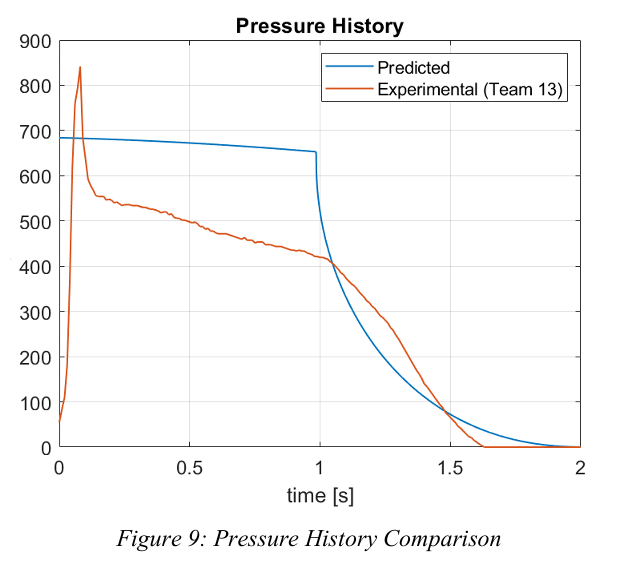
Comparison between the measured flight data and the simulation results showed strong agreement, indicating that the developed models accurately captured the rocket's overall performance. The altitude code predicted a maximum altitude of 2,224 feet, while the actual measured altitude was 2,470 feet, corresponding to an error of only 9.96%. Several factors likely contributed to the discrepancy, including uncertainty in the rocket's drag coefficient, variations in launch angle, changing wind conditions, and differences between the modeled and manufactured grain geometry. Additionally, the as-built motor contained approximately 11.35% more propellant than assumed in the simulation, providing greater total impulse than predicted. Despite these sources of uncertainty, the relatively small prediction error demonstrates that both the pressure and trajectory models provided a realistic representation of the motor's performance and flight behavior, validating the overall design methodology used throughout the project.